1989 BMW M3 Evolution: The Legendary Sleeper's Untold Story
Launched in the late 1980s, the BMW M3 Evolution I represents a pivotal moment in motorsport history, transforming a humble compact sedan into a track-dominating force. Emerging under the strict regulations of Group A touring car racing, this iteration of the E30 platform showcased engineering brilliance that blurred the lines between road legality and race preparation. The year 1989 specifically marks the maturation of this model, where initial concepts evolved into a highly refined and competitive machine. Owners and enthusiasts alike recognize this generation not just for its performance, but for the raw, analog driving experience it delivers, cementing its status as a cherished classic among BMW purists.
Genesis of a Racing Icon
The story begins not on the tarmac of a race track, but within the administrative halls of BMW AG. Facing rising competition in touring car racing, the company needed a homologation special to meet Group A rules, which required a minimum production run. The solution was to take the new E30 3 Series and strip it down, lighten it, and turbocharge it. The resulting M3, introduced for the 1986 model year, was already a revelation. However, the relentless pace of development meant that by 1989, the car had evolved significantly from its early counterparts. The 1989 model year became a sweet spot of availability and desirability, offering the peak of the early Evolution I's racing pedigree while remaining accessible to the dedicated enthusiast.
Mechanical Mastery Under the Skin
Powering this engineering marvel was the S14 engine, a four-cylinder masterpiece that screamed in harmony with the chassis. While the base model produced around 175 horsepower, the high-output Evolution version found in the 1989 model year pushed the boundaries with approximately 186 to 200 horsepower, depending on the market and specific tuning. This power was transmitted to the rear wheels via a close-ratio 5-speed manual transmission, ensuring that every surge of torque reached the ground with precision. The suspension was reworked with stiffer springs, gas-filled shock absorbers, and adjustable anti-roll bars, while the iconic front and rear spoilers were not merely cosmetic. These aerodynamic elements were crucial for high-speed stability, keeping the car planted and predictable when pushing the limits on circuit or back road.


Design and Aerodynamics: Form Follows Function
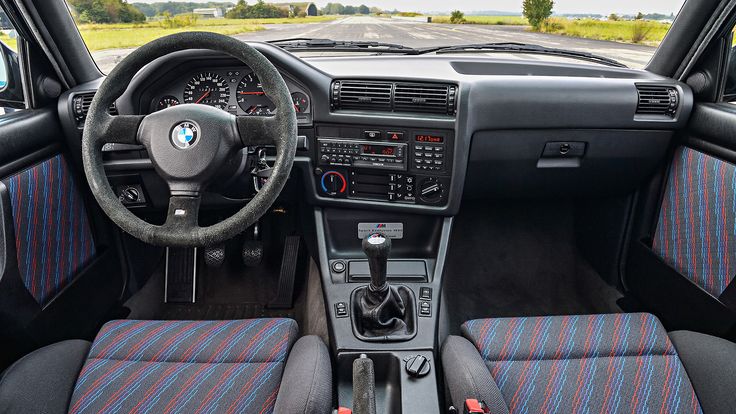
Visually, the 1989 BMW M3 Evolution I is instantly recognizable. The design language is aggressive yet purposeful, with every curve serving a function. The flared wheel arches accommodate the wider track and larger wheels, while the front bumper houses a deeper air dam to channel air efficiently. The rear is dominated by the legendary "whale tail" spoiler, a signature piece that generated crucial downforce without adding excessive drag. Inside, the driver was greeted by a race-inspired cockpit featuring bucket seats, a flat-bottomed steering wheel, and a forest of analog dials. The Recaro bucket seats, in particular, became iconic, providing the necessary lateral support for aggressive cornering while maintaining a level of comfort suitable for spirited road driving.
| Specification | Detail |
|---|---|
| Engine | 2.3L Inline-4 (S14) |
| Power Output | ~186-200 hp (market dependent) |
| Drivetrain | Rear-Wheel Drive |
| Transmission | 5-Speed Manual |
| Suspension | Double wishbones, Anti-roll bars |
| Brakes | Disc brakes, typically with ABS option |
Driving Dynamics and Legacy
To drive a 1989 BMW M3 Evolution I is to engage in a dialogue with the road that modern, overly-assisted cars rarely facilitate. The steering is heavy yet communicative, the chassis reacts instantly to driver input, and the manual transmission requires deliberate, precise shifts. This raw feedback loop between driver and machine is the core of its appeal. It demands skill and respect, rewarding confident inputs with exhilarating grip. The legacy of this car is immeasurable; it pioneered the "Sport Compact" segment and proved that small, lightweight cars could outperform much larger, more powerful vehicles. It established BMW's reputation for building driver-focused machines, a philosophy that continues to define the brand today.


Collector's Dream and Cultural Impact
Decades later, the 1989 BMW M3 Evolution I commands significant respect and value in the collector's market. Original, well-maintained examples with documentation are highly sought after. The car's appearance in popular culture, most notably in the hit television series "The Fast and the Furious," skyrocketed its fame and introduced the icon to a new generation. This cultural saturation, however, does not diminish its core purpose. It remains a serious driver's car, a testament to an era when engineering focused on balance and driver engagement over brute force and digital trickery. For those fortunate enough to own or simply admire one, it represents the purest expression of the BMW M division's early commitment to motorsport excellence applied to the production car world.
The Enduring Appeal
What truly sets the 1989 M3 Evolution I apart is the emotional connection it fosters. The mechanical clatter of the engine, the tactile feel of the gear knob, the sight of the whale tail spoiler in the rearview mirror—these are the details that create lasting memories. It is a car that has aged with dignity, its design cues still influencing modern BMW M models. While modern technology offers staggering levels of performance, the raw, unfiltered nature of the 1989 M3 provides a driving purity that is increasingly rare. It is a bridge between the analog past and the digital present, a reminder of a time when the driver was an integral part of the machine, and every mile was an experience.


Related Articles

BMW M12 F1: The Legendary Engine's Untold Story
The BMW M12/13 represents one of the most fascinating and successful pieces of machinery in the history of Formula One. This 1.5-liter turbocharged...

Eazy E BMW 850CSI: The Legendary Ride's Untold Story
The Eazy E BMW 850CSI represents one of the most fascinating and sought-after collector cars to emerge from the European automotive scene in the late 1980s...

Toyota Built Boats: The Untold Story of The Legendary Automaker's Maritime Mishaps
When searching for information on maritime manufacturing, the query "toyota made boats" often surfaces, prompting curiosity about a potential connection...

The Legendary BMW BJ 1939: The Untold Story of the First BMW Off-Roader
The BMW BJ 1939 represents a fascinating, albeit often overlooked, chapter in the evolution of German engineering and military mobility. While not a vehicle...

Toyota War Chad: The Untold Story of the Legendary Battle
In the harsh and unforgiving landscape of the Tibesti Mountains, a conflict unfolded during the 1980s that came to be defined by its most unlikely asset: aging...

Toyota Hilux Iraq War: The Legendary Beast's Untold Battle Story
The Toyota Hilux has become an almost mythical symbol within conflict zones, particularly when examining the Toyota Hilux Iraq war legacy. Often described as...